


Popular Searches


Blogs and How to Guides


A truly exceptional quartz worktop isn’t defined by colour or finish alone — it’s defined by how seamlessly it belongs in your space. In premium kitchens, perfection lives in the details: the way stone meets the wall, the absence of gaps, and the effortless flow around architectural features.
This level of refinement is achieved through expert techniques such as scribing and notching. While often overlooked, these precise processes are what separate a standard installation from a beautifully tailored one.
In this article, we explore why scribing and notching matter, how they’re done, and why they’re essential when investing in a quartz worktop that’s designed to look flawless for years to come.
What is Scribing?
Scribing is the process of tailoring the back edge of the stone to follow the exact "wavy" or irregular profile of your kitchen walls.
Even if a wall looks straight to the naked eye, it likely has subtle bows, humps, or leans. If you were to place a perfectly straight slab of quartz against it, you would see unsightly gaps. Scribing eliminates these gaps, ensuring a tight fit that prevents food debris or moisture from disappearing behind your units.
How it’s done:
- Template Tracking: During the templating phase, our template specialist uses a digital laser scanner to record every micro-deviation in the wall's surface.
- Precision Cutting: Back at the workshop, a CNC machine with a skilled stone mason trims the back of the quartz worktop to match that specific line.
- The Result: The stone sits flush against the wall. This is particularly vital if you aren't planning on using a tiled splashback or upstands to hide gaps.

What is Notching?
While scribing handles the long, horizontal runs, notching is all about the fine details. Notching involves cutting small, precise "steps" or recesses into the stone to allow it to wrap around fixed architectural features like walls, pipes, or other obstacles. Think of it as a clever little adjustment that helps your kitchen worktop sit snugly against the wall without leaving awkward gaps. This is especially important in kitchens, where plumbing and electrical connections often get in the way. By adding a notch, you get a neat, seamless finish that looks polished and professional.
This is most common around window cills, door architraves, or protruding pillars. Without professional notching, you would be forced to cut your window cill or wall to fit the stone, which often looks messy and unfinished.
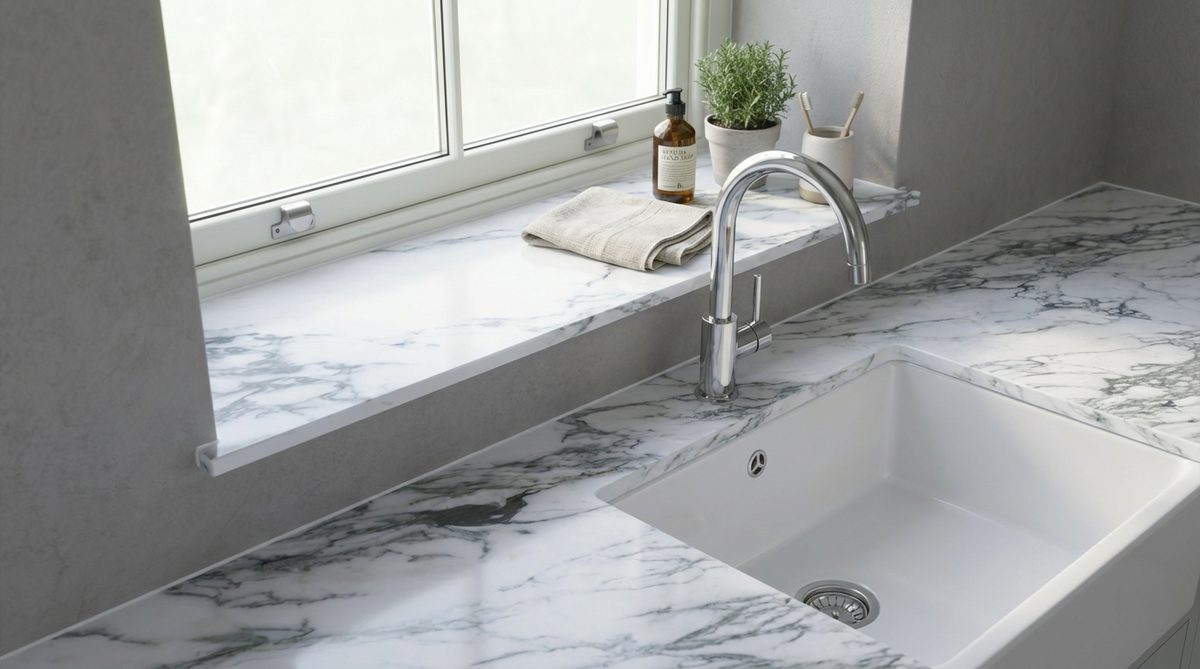
Common areas for notching
- Window Cills: Where the quartz worktop extends into the window reveal to create a continuous surface.
- Corner Pillars: Fitting the stone around structural supports or boxing.
- End Panels: Creating a neat "return" where the worktop meets a tall larder unit.
But what happens when you have two obstacles close together - say, a pipe and a pillar? That’s where the double notch comes in. A double notch is simply two cut-outs in the same section of the worktop, allowing it to fit perfectly around multiple features. It’s like tailoring your kitchen worktop to the unique shape of your space, ensuring everything lines up beautifully.
Notches aren’t just practical - they can also be a subtle design detail. When done well, they make your kitchen look custom-built, with no unsightly gaps or uneven edges. So next time you’re planning a kitchen, remember: these little cut-outs make a big difference in achieving that flawless finish.
A Triple notch brings precision and character to a worktop installation. Instead of a single cut, three carefully measured notches are shaped to navigate multiple obstacles - such as uneven walls, exposed pipework, or structural columns—without compromising the flow of the countertop.
Each notch is cut with intent, allowing the kitchen worktop to slot perfectly into place while maintaining clean lines and a seamless finish. When done well, a triple notch isn’t just practical; it becomes a subtle statement of craftsmanship, transforming a challenging space into a refined, custom-fitted design.

Why These Techniques Matter
Beyond just looking beautiful, these techniques are functional requirements for a long-lasting kitchen:
- Hygiene: Tight joins mean no breadcrumbs or liquids can seep into the voids behind your cupboards, which can cause odours or mould over time.
- Structural Integrity: Properly scribed kitchen worktops distribute weight more evenly and reduce the stress on the stone.
- The "Seamless" Look: It creates the illusion that the quartz grew out of the wall, providing that high-end, bespoke finish that defines a luxury kitchen.
Pro Tip: Always check if your quote includes "scribing" or "notching" and your professional templater will discuss this with you following using digital scanning technology to accurately measure these cuts ensuring the perfect fit before the stone even arrives at your home.
Here is a checklist of focused questions to mention in your Design Consultation – why not book a call today! This ensures they know you value precision and that scribing and notching are included in your project scope.
The Stone Mason’s Technical Checklist
1. "How do you account for wall irregularities during templating?"
You want to hear them mention digital templating (Prodim or laser scanners) or physical scribing. If they just say "we take a few measurements," they might rely on thick beads of silicone to hide gaps later, which isn't the premium finish you’re after.
2. "Is the cost of scribing included in the quote, or is it an extra 'on-site' charge?"
Our prices are based on "straight cuts" only. If your walls are particularly bowed, there are extra charges as it is a very labour-intensive process of tailoring the stone to your kitchen walls and window cills.
3. "Can you provide 'notched' returns for my window cills?"
Notching around a window reveal is a sign of a high-end installation. This creates a seamless transition where the worktop flows into the cill. This is much cleaner than having a separate piece of stone "butted up" against the worktop.
4. "What is your 'maximum gap' tolerance before an upstand is required?"
If you aren't using upstands (the small strips of stone that run up the wall), the scribe needs to be incredibly tight (usually within 2-3mm). Knowing their tolerance helps you decide if you need that extra bit of trim to hide the join.
5. "Do you use CNC machinery for complex notches and shapes?"
CNC (Computer Numerical Control) machines allow for incredibly intricate notching that is perfectly smooth. Hand-cutting is possible, but for quartz worktops, a CNC finish is often much more “surgical” and crisper.
Helpful Tips for your Design Call
- Show, Don't Just Tell: If you have a specific "problem area" - like a chimney breast or a window cill that isn't square - take a photo of it and show your Design Consultant. Ask, "How will the stone be notched to wrap around this?"
- Check the Edging: Ask if the polished edge continues into the notch. Polishing the tiny "returns" inside a notch, can make all the difference in a visible area.
Request a Quote & Free Samples
Interested in a quartz worktop for your kitchen? Get in touch for a free, no obligation quote today.
You may also like...

The Perfect Joint: Ensuring quality Quartz Worktops with Gemini Worktops
Our expert worktop designers strive to avoid joints whenever possible. However, when a joint is essential, our professional installation team ensures that joints are of the highest quality.

Gemini Worktops: Proudly Made in Britain
At Gemini Worktops, we take immense pride in our heritage and craftsmanship and are honoured to carry the prestigious Made in Britain mark.

Stone, Perfected: The Art of Engineered Nature in the Family Home
Engineered quartz countertops bring the beauty of natural stone with durability for modern family life - stylish, resilient, and built to last.

Worktop Feng Shui: Harmonise Your Kitchen for Optimal Flow and Efficiency!
Discover how Feng Shui can fill your home with harmony – and how you can transform your kitchen with a few simple changes.